Rexroth 4WRZE: Cylinder Jump at Startup
A cylinder that remains still and then suddenly moves calls for examining what happened before motion. Compare three timelines: command buildup, pilot-pressure establishment and the force required to start the load.
This article addresses 4WRZE component series 7X using RE29115/10.05. The available OEM excerpt identifies a pilot-operated proportional directional valve with integrated electronics and no electrical position feedback. It does not support assigning a universal minimum pilot pressure or ramp setting.
Check whether the command skips the slow-start interval
Suppose a feeder receives a direct step from zero to 30% command. Once the opening develops, the corresponding flow can accelerate the cylinder sharply. At a light load with substantial available differential, the same opening can pass more flow than under a heavy load.
If the command record shows a step immediately followed by acceleration, check program speed changes, ramps and limits first. Rapid motion following a command step cannot all be assigned to an internal valve defect.
A smoothly changing operator display can also conceal a short jump in the actual controller output. Use the controller's available trends or commissioning records to examine the output itself.
Pilot conditions may develop after the command
The 4WRZE pilot valve controls its main stage, which needs the appropriate pilot supply and drain conditions. Integrated electronics do not establish the presence of electrical main-spool position feedback.
Assume a standby circuit unloads the main supply. At startup, the speed command arrives before main pressure is restored. In the relevant internally piloted arrangement, pilot driving conditions may therefore develop after the command. The main stage responds later, concentrating movement into that later interval.
If a position controller has accumulated output while no movement occurred, the eventual opening can be larger still. Compare error, output limits and integrator handling where such a controller is actually used. This is not a feature present in every 4WRZE installation.
Align pilot readiness with motion permission through the machine design. The correct supply arrangement and sequence cannot be reduced to one pilot-pressure value for all sizes.
Breakaway force can exceed running resistance
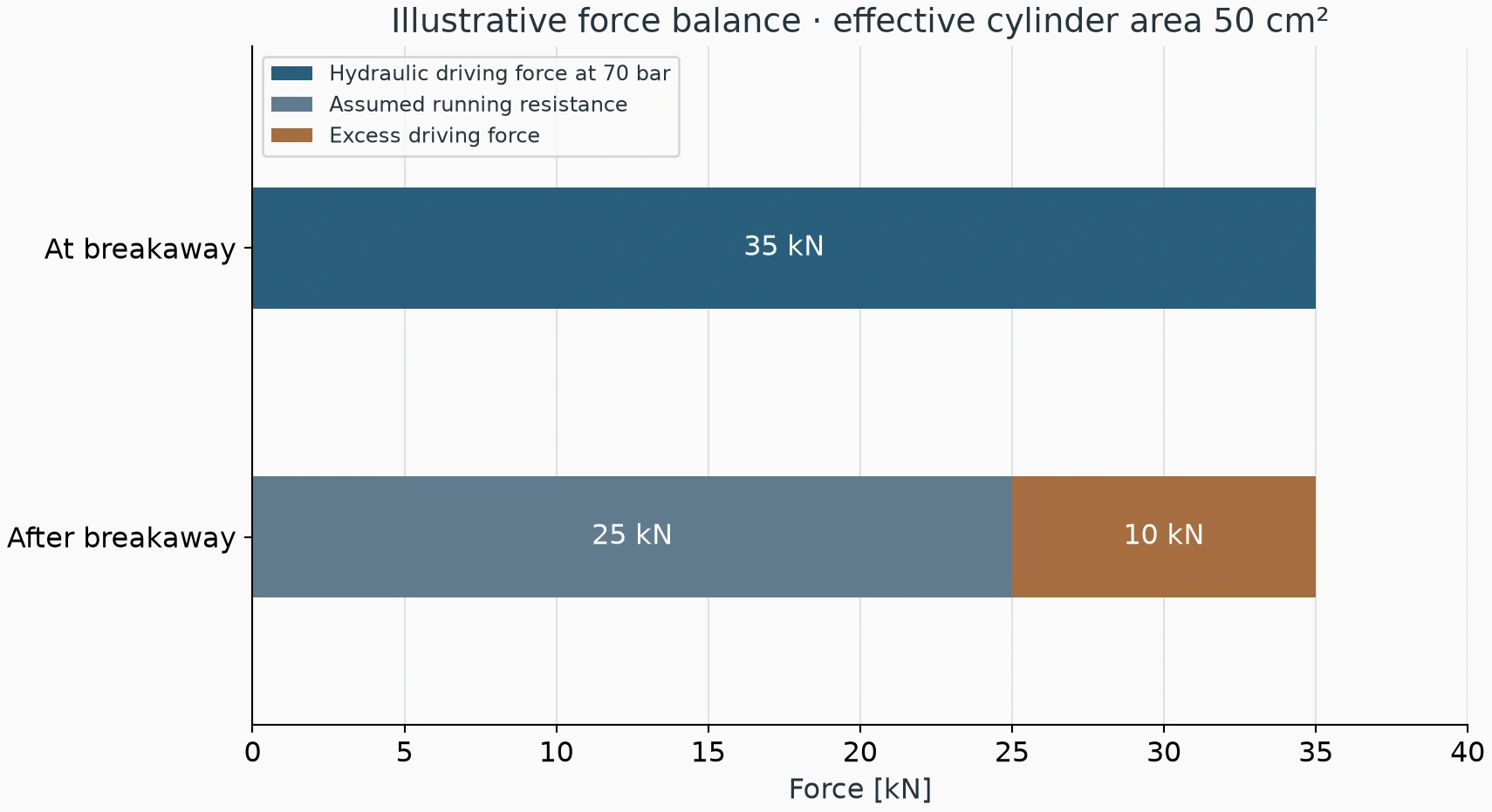
Assume a horizontal cylinder with an effective area of 50 cm². Starting movement requires 35 kN, while running resistance falls to 25 kN. Ignoring return pressure, those forces correspond to approximately 70 and 50 bar.
If pressure reaches 70 bar before movement and resistance then falls while pressure remains temporarily near 70 bar, roughly 10 kN of excess driving force is available for acceleration. This can produce a pause followed by a jump.
If the symptom worsens after a long dwell and improves during repeated movement, inspect seals, guide lubrication, misalignment and interference. If it occurs at the same stroke position, local mechanical resistance deserves attention beyond the startup ramp.
What improvement from a slower ramp establishes
Assume changing the rise from zero to 30% from 0.3 seconds to 1.5 seconds makes startup smoother with other conditions unchanged. It establishes that a lower command rate helps that operating point. It does not prove the original cause was entirely electrical.
A slower rise can also provide time for pressure buildup, overcoming static friction and accelerating the mechanism. Compare starting pressure, delay and subsequent speed to ensure the change has not simply replaced the jump with a long pause.
The 0.3 and 1.5 second values illustrate a comparison, not recommended series settings. Ramp selection must account for cycle time, positioning and permissible acceleration and be implemented by authorised commissioning personnel.
Neutral passages and load holding affect the first movement
The cited document identifies small neutral A/B-to-T connections for certain spools, including W6 and W8. Neutral arrangements differ and affect chamber pressure during a stop and conditions at restart.
Where a separate holding device supports the load, startup may also involve its release. Opening conditions, pilot lines and release timing require the actual circuit drawing. A jump cannot always be attributed to excessive main-directional-valve opening speed.
During replacement, preserve the required neutral symbol and pilot configuration. Changing neutral passages or drainage can change how the existing sequence behaves. Matching nominal flow alone does not preserve stop and start behaviour.
| Timing or location | Observation | Priority investigation |
|---|---|---|
| Command step followed immediately by acceleration | No substantial preceding delay | Output transition, ramp and flow setting |
| Command established before pressure, then movement | Delayed concentrated response | Pilot conditions and sequence |
| Pressure rises before movement and drops afterwards | Breakaway followed by sliding | Static friction, resistance and load release |
| Repeated at the same stroke position | Not tied to one startup interval | Guides, alignment and local interference |
| Appeared after valve replacement | Stop and start behaviour changed | Neutral spool, pilot and holding configuration |
Record command, pressure and motion in sequence
Using existing trends and gauges, compare when the command appears, pressure develops and motion begins under a consistent load. Without fast pressure recording, note the order without presenting a slow gauge reading as a transient peak.
Compare a long-dwell start with repeated movement, and an approved slower start with the normal command. Stay within the machine's permitted operating conditions and retain interlocks and load-holding measures.
Use the sequence to select the next check: an immediate command step directs attention to output transitions; late pilot readiness to supply and timing; pressure buildup followed by sudden motion to breakaway resistance. This is more useful than applying the same parameter change to every startup jump.