Parker PVP Pressure Is Normal but the Cylinder Is Slow
A gauge reaches 160 bar, but the cylinder is slower than before. That establishes pressure at the gauge, not simultaneous delivery of the required flow.
Parker PVP varies displacement by changing swashplate angle. Standard pressure compensation reduces displacement at its setting, so high pressure and low flow can coexist. The following concerns standard pressure-compensated control; load-sensing and horsepower-limiting options have additional functions.
Calculate effective inlet flow from stroke time
Assume an 80 mm bore cylinder extending 300 mm. Full-bore chamber volume for the stroke is approximately 1.508 L.
Three seconds: Q ≈ 1.508 × 60 / 3 = 30.2 L/min.
Five seconds: Q ≈ 1.508 × 60 / 5 = 18.1 L/min.
Even with the same 160 bar pump reading, effective cylinder inlet flow falls approximately 40%. The calculation uses the same direction and load, excluding cylinder cross-port leakage and compression.
Compensation deliberately reduces delivery
PVP pressure-compensated control acts through a servo piston to reduce swashplate angle. When a cylinder stops using oil at the end of travel, maintaining pressure with reduced delivery is normal.
If load, valve and piping losses bring pump pressure close to the compensator setting during motion, the pump can also enter its reduced-displacement region. Opening the directional valve farther may not restore missing flow.
For example, load rises from 120 to 145 bar and valve and line losses need another 15 bar, bringing demand to 160 bar. With compensation set to 160 bar, higher speed encounters insufficient pressure allowance. Raising the setting also increases system pressure exposure and is not a universal repair.
Nameplate displacement does not establish current delivery
Nominal displacement describes the applicable maximum-displacement condition. Volume-stop adjustment, compensation, remote control and horsepower limiting can all affect actual swashplate position.
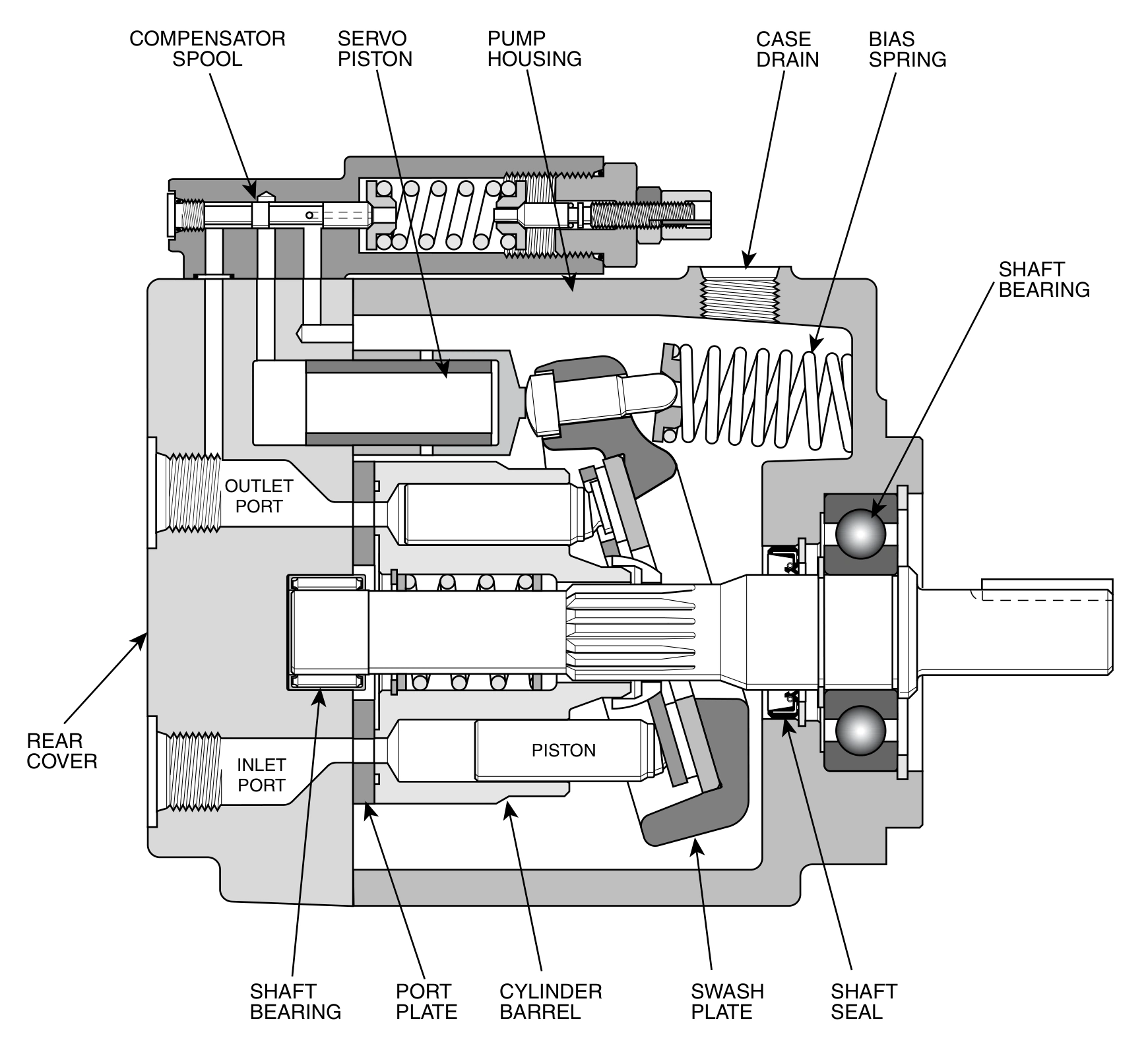
The July 2023 PVP catalog distinguishes standard pressure compensation, remote pressure, load sensing and horsepower control. Do not apply one control's behavior indiscriminately to the others.
Displacement and speed determine theoretical delivery, so record speed when motion slows. A 33 cm³/rev pump has theoretical delivery of 49.5 L/min at 1500 r/min and 39.6 L/min at 1200 r/min, 20% less before leakage. Pressure can remain similar while speed changes reduce cylinder flow.
Adequate pump flow can still leave a branch short
With verified pump delivery, examine simultaneously operating branches, relief or unloading paths and restrictions toward the slow cylinder. Another branch taking more oil changes available distribution.
Compare the same cylinder alone and during combined movement. Normal single-axis speed but slow combined motion calls for total-demand and distribution measurements. Slow operation alone calls for further branch pressure-drop, signal and leakage checks.
Do not close protection valves, block case drain or deadhead for prolonged periods to prove flow. Flow testing requires suitable instruments and a controlled load circuit.
Gauge location matters
A 160 bar pump reading does not establish 160 bar at the cylinder; compare pressure losses along the flow path. If the pump-to-valve path loses 5 bar and the valve-to-cylinder path another 20 bar, cylinder inlet pressure is approximately 135 bar. Return backpressure further reduces effective force.
Restrictions often become more significant at higher flow. If slow movement has force but rapid movement does not, compare pressures during motion, not just the peak reading after stopping.
Records without opening the circuit
Record identical-direction stroke time, temperature, gauge location and readings during movement, and differences between single and combined operation. Include existing speed or inverter readings. Do not disconnect pressurized fittings.
Reduced flow while holding end-of-stroke pressure agrees with compensation. Motion slowing near the pressure setting calls for load and pressure-margin checks. Normal single-axis movement but slow combined motion calls for total supply and allocation checks. Pressure and movement time together reveal a possible flow deficit.