MOOG D661: Internal vs External Pilot Supply
The D661 uses a pilot stage to move its main spool. Internal or external pilot supply should be selected by checking pressure during startup, operation, unloading and shutdown. Adequate pump pressure during steady operation does not establish adequate pilot conditions throughout every transition.
The operating explanation below uses the historical D660 catalog CDL6562 Rev H, issued in 2005. Pressure limits and fail-safe positions require the manual for the actual valve. The March 2025 D661 G/S/H installation instructions are retained for configuration-specific installation review, rather than used to add ratings to an older valve.
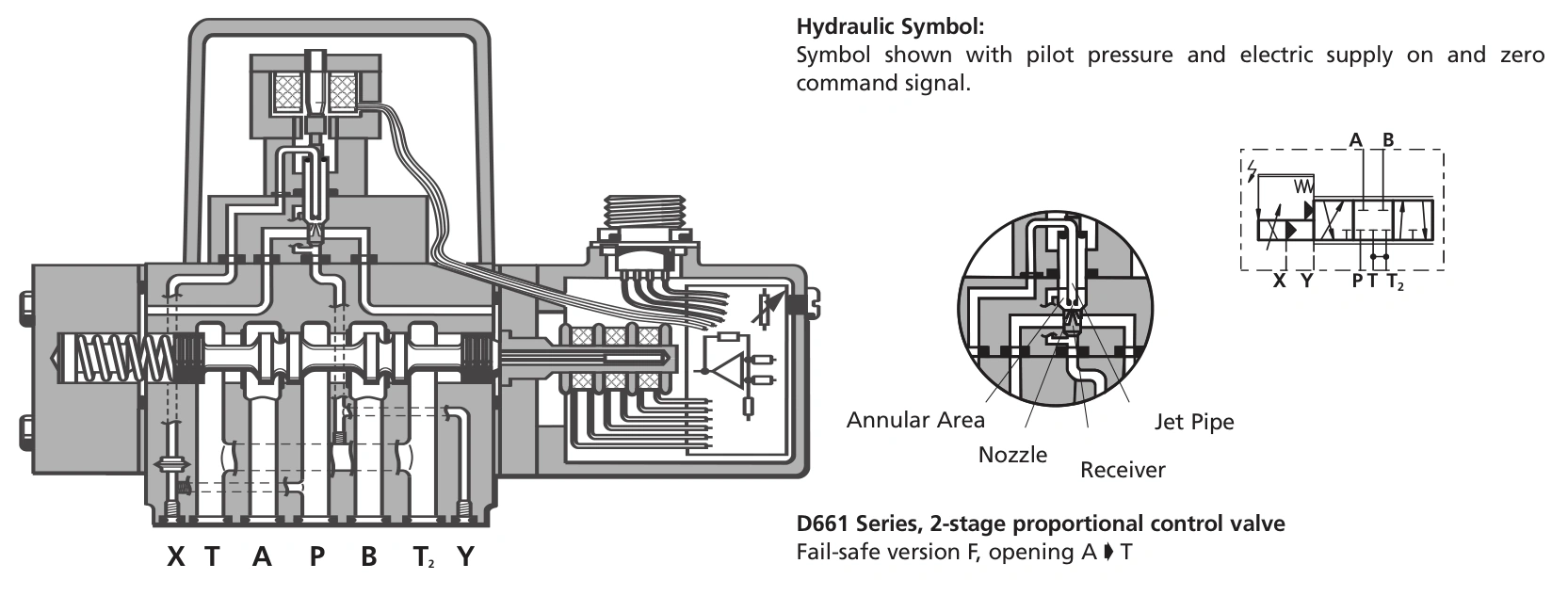
Internal supply comes from P; external supply comes through X
Internal pilot supply takes control oil from main port P. Where the main circuit already maintains adequate pressure, this provides a straightforward supply path without a separate pilot-pressure source.
External supply feeds the pilot through X. It allows pilot conditions to be arranged separately from main pressure, which can help when control is required during low-pressure or unloaded operation. The additional supply, filtration, regulation and piping must all be provided.
Y is the pilot drain. External drainage routes pilot return separately, while internal drainage uses the corresponding internal return path. Pilot supply and drainage are independent configuration choices. A separate Y line does not establish that the valve has external X supply.
An 8 bar unloaded main circuit may not support pilot operation
Assume P is 120 bar during operation and falls to 8 bar during standby unloading. If the program requires a valve transition during that unloaded phase, an internally supplied pilot must be checked at that lower pressure.
The cited historical catalog gives a basic requirement of pilot supply approximately 15 bar above pilot return, and notes that higher pilot pressure may be needed at high flow and valve differential. With only 8 bar at P, even a near-zero return cannot meet that historical requirement.
Increasing the electrical command cannot provide the missing hydraulic driving pressure. Depending on the complete circuit and its safety functions, engineering options include retaining sufficient main pressure, revising the designed sequence or providing a stable external pilot supply.
Subtract Y backpressure from a 30 bar external supply
The pilot works with the differential between supply and return. Assume X is 30 bar and Y is 5 bar: the available differential is 25 bar. If a shared return raises Y to 22 bar, only 8 bar remains.
The latter condition falls below the historical basic requirement of about 15 bar. A gauge showing 30 bar at the external supply does not establish a 30 bar effective pilot differential.
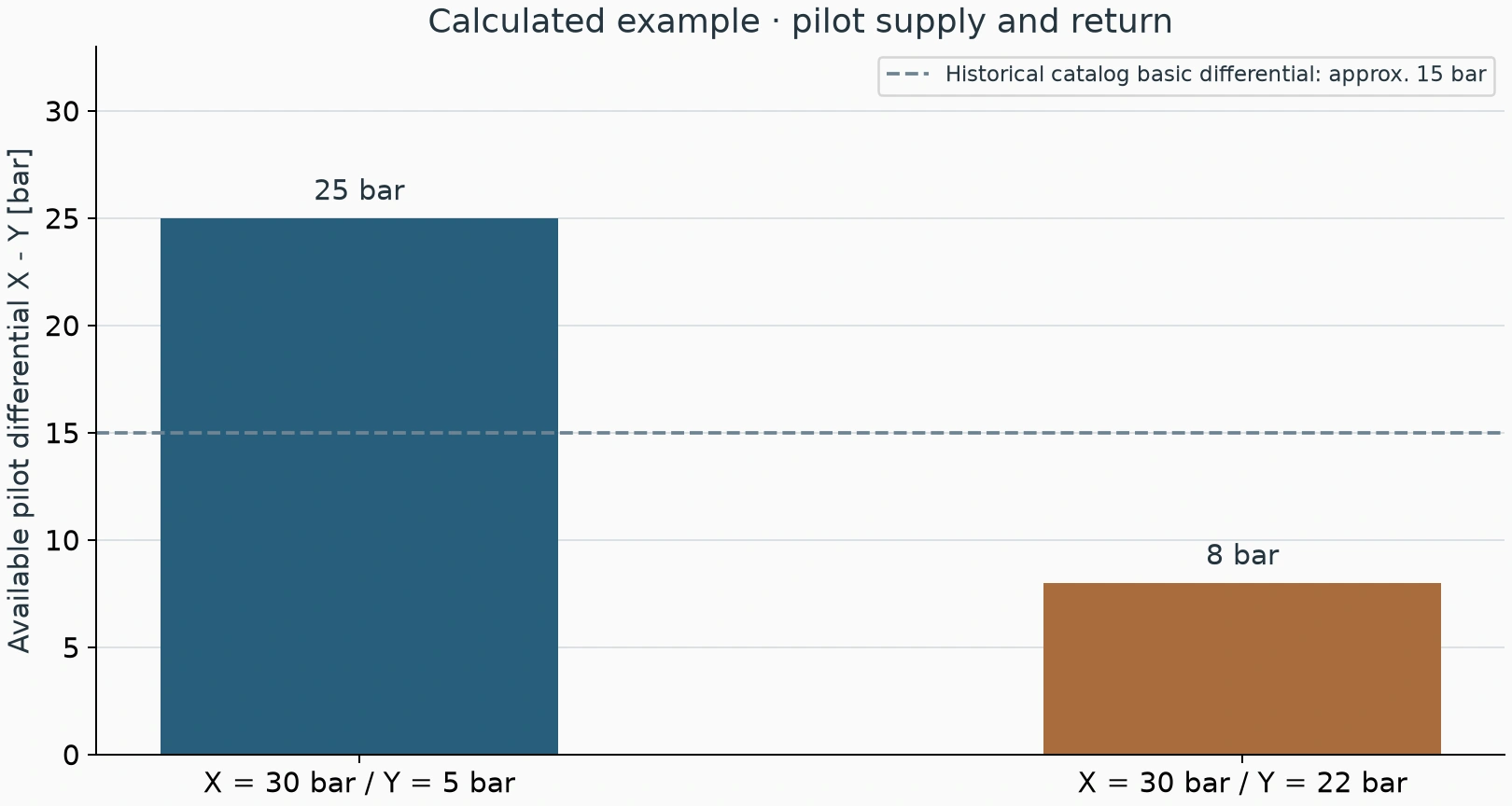
This gives a practical investigation route when one axis works normally alone but responds poorly while several axes return oil simultaneously. Compare X and Y during the event, and check T pressure and the applicable valve limits. A static unloaded supply reading is insufficient.
Choose by circuit operating states
| Circuit condition | Arrangement to evaluate | Deciding requirement |
|---|---|---|
| P remains adequate during every required motion phase | Internal supply | Sufficient differential, pilot flow and cleanliness |
| Main pump frequently idles at low pressure while valve control is needed | External supply or an engineered pressure-retaining arrangement | Pilot differential available during low-pressure operation |
| Main pressure varies substantially | Regulated external supply | Regulation capacity and actual X/Y differential |
| Shared return has significant pressure pulsation | Drainage arrangement assessed separately | Changing supply alone may leave return-pressure problems |
| A specified state is required after electrical or pressure loss | Correct fail-safe configuration and machine validation | Supply, drain and electrical conditions together |
External supply does not automatically increase main flow or accuracy. Internal supply can meet the duty where main pressure remains sufficient and stable. An unstable external source, inadequate filtration or poor drainage can introduce new problems.
Include pilot-pressure buildup in the startup sequence
Suppose a small independent pump supplies the pilot and the main pump supplies the actuator. Starting both and immediately commanding movement can produce an initial response different from steady operation if pilot pressure has not yet developed.
Record the timing of pilot-pressure buildup, valve command and actuator motion. Establish the motion-permission conditions through the machine design. Changing to external pilot supply requires checking the startup sequence as well as the piping.
Shutdown order also matters. Stopping the pilot pump before unloading the main circuit can change the transition toward the specified valve state. Actual fail-safe behaviour depends on valve configuration, pressure conditions and the machine circuit. Zero command is not a universal load-holding measure.
Record working, standby and simultaneous-motion conditions
Where suitable measuring points exist, record supply and return pressure during normal work, standby unloading and simultaneous actuator operation. A symptom occurring in only one state makes the differences more useful than a general note saying that pilot pressure is normal.
Without suitable measuring points, identify supply and drain paths from the circuit drawing and record the symptom's relationship to unloading, startup and other-axis movement. Qualified personnel can then arrange simultaneous pressure measurement. Do not change internal plugs or reconnect pressurised lines as an informal test.
Select D661 pilot supply to maintain sufficient, stable and clean control oil throughout every required operating state, with acceptable return pressure. Internal supply suits circuits whose main pressure meets that requirement throughout. External supply suits applications needing independently maintained pilot conditions, provided X supply, Y drainage and the operating sequence are designed together.