HYDAC SB330: Shorter Pressure Holding and Leakage Checks
Shorter pressure holding can result from less usable stored oil or greater oil consumption. Pre-charge checks and comparable operating records help separate these effects.
This SB330 discussion follows HYDAC's gas-sizing approach. The simplified scenarios are calculations, not a diagnosed machine case.
Holding time depends on usable oil and consumption
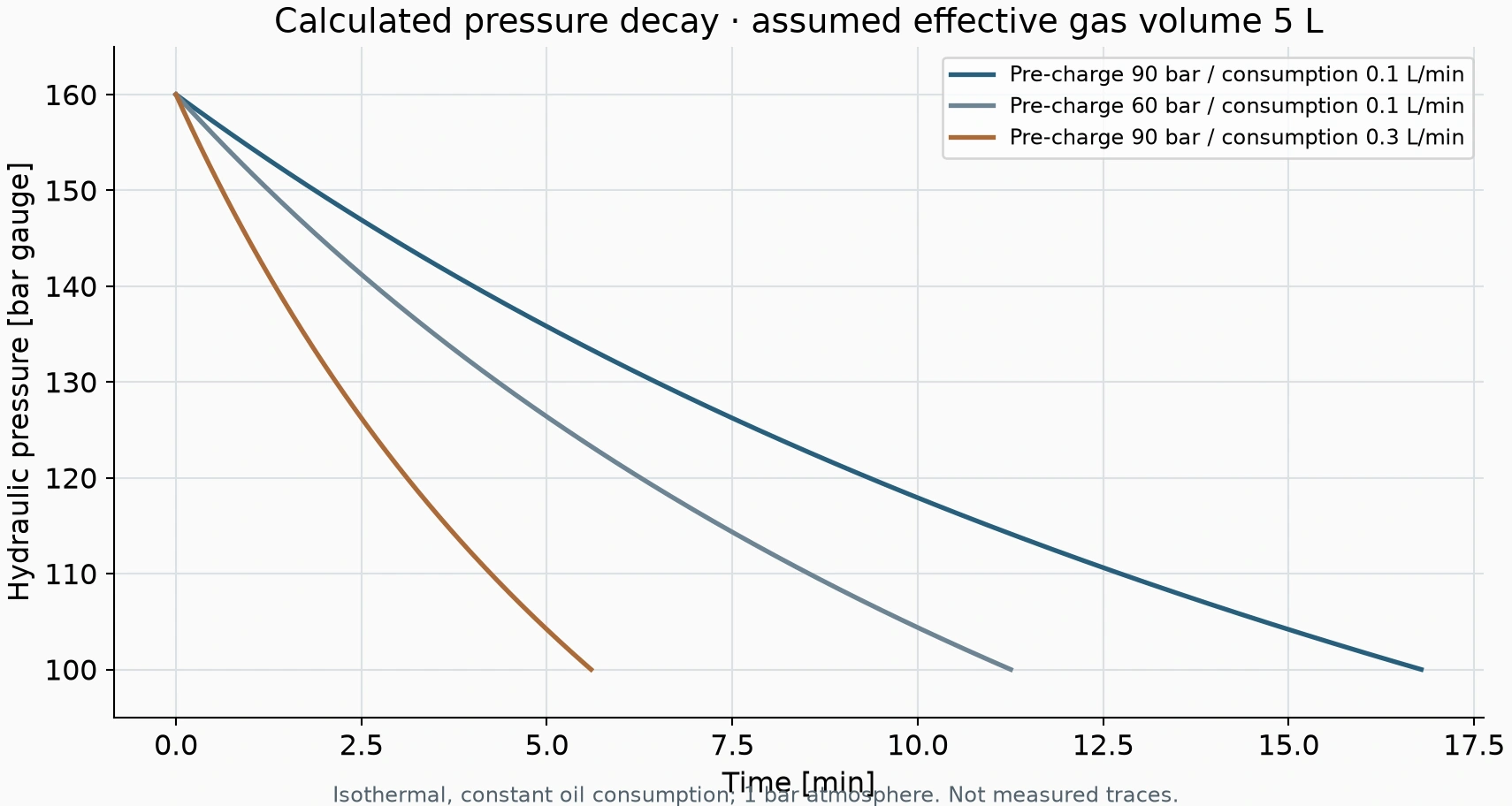
Assume effective gas volume of 5 L, pre-charge of 90 bar and an operating range from 160 down to 100 bar, all gauge pressures. With 1 bar atmosphere and slow isothermal discharge, usable oil is approximately 5 × 91 × (1/101 − 1/161) = 1.68 L.
At an assumed average oil consumption of 0.1 L/min, theoretical holding time is 16.8 minutes. At 0.3 L/min it falls to 5.6 minutes. Consumption may include leakage and intended use, depending on machine state.
Pressure decay is not linear, and actual leakage varies with pressure and temperature. Constant consumption is used here only to explain the relationship.
Lower pre-charge also changes usable volume
At 60 bar gauge pre-charge, or 61 bar absolute, the same example provides approximately 1.13 L. At 0.1 L/min consumption, theoretical time becomes about 11.3 minutes.
Reduced pre-charge can therefore shorten holding, but a decrease from 16.8 to 5.6 minutes does not establish that cause. Measure pre-charge and assess leakage and operating state.
Qualified personnel must check pre-charge with compatible equipment after hydraulic isolation and depressurisation under the specified procedure. A running hydraulic gauge does not directly measure gas pre-charge.
With correct pre-charge, investigate oil consumption
If pre-charge meets the design value and duty and temperature are comparable, faster decay warrants checks of valve returns, cylinder internal leakage and other consuming branches.
For example, an auxiliary mechanism operating periodically may withdraw stored oil. Align its operating record with pressure trends to distinguish that demand from reduced storage capacity.
Do not casually isolate a load-bearing circuit, loosen connections or bypass interlocks. Use existing machine records first; qualified personnel should perform further isolation tests under the machine procedure.
Compare warm and cold behaviour carefully
Temperature changes leakage and gas conditions. If holding deteriorates only warm, compare the same load and pressure range. A single gas-pressure reading at a different temperature does not prove gas loss.
Record pre-charge measurement temperature. Changed load, duty or minimum permitted pressure can also reduce usable delivery and holding time.
| Finding | Follow-up |
|---|---|
| Pre-charge below design | Correct under procedure, investigate gas loss and repeat duty |
| Correct pre-charge, faster consumption | Leakage, auxiliary use and holding devices |
| Pressure changes coincide with another action | Shared-branch demand |
| Warm-only deterioration | Temperature, leakage and gas state |
| Pressure falls while position stays stable | Assess against required machine function |
Use a repeatable method where tools are limited
Start with existing gauges or trends during a normally permitted holding step. Record start pressure, minimum permitted pressure, elapsed time, oil temperature and other machine actions. Do not alter interlocks or load-bearing conditions to create a test.
Suppose comparable daily observations from 160 to 100 bar take 16, 15.5 and 16 minutes. A later repeatable fall to 6 minutes under the same conditions warrants further investigation.
Mark any clamp replenishment, auxiliary motion or pump reload during the observation. Such records differ from an uninterrupted holding period and should be compared separately.
Cylinder position adds information
Pressure falling with unchanged position means no obvious movement was observed during that period, but other oil consumption may remain. Pressure decay accompanied by cylinder movement also calls for actuator, holding-device and load checks.
Identify whether the gauge measures the system or accumulator side. After circuit separation, one side's pressure cannot establish the other's state. Locate the measuring point on the circuit drawing.
Repeat the same duty after restoring pre-charge
If qualified checking finds pre-charge below design and it is corrected under procedure, repeat the observation at comparable temperature, load and pressure range. Recovery supports a contribution from pre-charge; persistent short holding calls for further hydraulic-loss checks.
Keep the checked value, temperature and date. Repeated loss warrants investigation of gas-valve sealing, bladder and associated components rather than treating repeated charging as a completed repair.
Distinguish pump-maintained pressure from stored-energy holding
Automatic replenishment can produce repeated pressure falls and rises. Record the interval between replenishments and machine state, but do not apply a single-discharge calculation unchanged.
Shorter intervals can reflect switching settings, intended use, hydraulic losses, accumulator capacity or pre-charge. Motor-start count alone does not determine the required gas charge.
Record repeatable pressure decay and check pre-charge. If pre-charge is correct, investigate consumption and circuit holding capability; adding nitrogen does not repair hydraulic leakage.