HYDAC Accumulator Precharge Too High or Too Low: Different Symptoms
After charging, an accumulator may still provide insufficient makeup oil or stop supporting pressure below a certain point. Both excessive and insufficient precharge can reduce usable delivery, but their symptoms differ.
The following concerns energy-storage makeup duty with a bladder accumulator. Precharge is gas pressure measured with the oil side depressurized as specified, not an independent setting read by simply attaching a gauge during operation.
Excessive precharge can end delivery early
If precharge exceeds working pressure, oil cannot readily compress the gas and enter. As system pressure falls near precharge, usable oil may already be nearly exhausted, leaving no continued support as pressure falls farther.
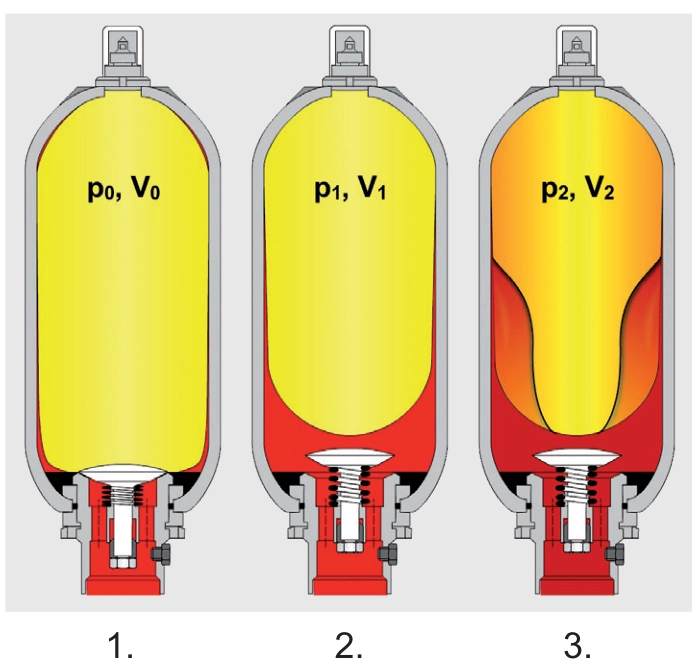
For example, a system needs delivery from 160 down to 100 bar but precharge is 120 bar. Near 120 bar the oil side may approach empty, so continued delivery down to 100 bar cannot be assumed.
HYDAC energy-storage guidance gives p₀ ≤ 0.9p₁, where p₁ is minimum working pressure. At a 100 bar minimum, 90 bar is the upper value from that relationship, not a universal precharge for every accumulator and purpose.
Lower precharge does not automatically give more usable oil
Less initial gas is compressed more at the same maximum pressure. More oil may enter, yet less can be released between the specified maximum and minimum pressures. Excessive compression ratio can also affect bladder operation.
For an idealized calculation, take 5 L initial effective gas volume, 160 bar maximum, 100 bar minimum and a polytropic exponent of 1.4. All pressures share a reference temperature. Use absolute pressure, approximated by gauge pressure plus 1 bar.
| Gauge precharge | Estimated usable oil from 160 to 100 bar |
|---|---|
| 50 bar | Approximately 0.87 L |
| 90 bar | Approximately 1.31 L |
| 120 bar | Approximately 0.92 L; gas reaches initial volume near 120 bar |
The model uses V(p) = V₀ × [(p₀ + 1)/(p + 1)]^(1/n), capped at the initial 5 L gas volume. The 120 bar case cannot be extrapolated as further gas expansion down to 100 bar. The 120 bar precharge exceeds the minimum working pressure in this example and illustrates early oil depletion.
How long can it cover a flow deficit?
Assume actuator demand is 30 L/min and the pump supplies 20 L/min. The accumulator covers a 10 L/min deficit. The table gives approximately 5.2 seconds at 50 bar precharge, 7.9 seconds at 90 bar and 5.5 seconds at 120 bar. The last case also loses continued support before the minimum target pressure.
Actual duration depends on flow variation, temperature and connection losses.
Short holding time is not always low nitrogen
An accumulator cannot stop leakage elsewhere. Correct precharge with increased valve or cylinder leakage still produces faster pressure decay. Frequent recharge can reflect reduced usable oil or increased leakage.
Compare holding time at the same pressure limits, load and temperature, recording active valves and actuators. Precharge checking requires proper oil-side isolation and depressurization and trained personnel using compatible nitrogen charging equipment. Do not loosen oil or gas connections to investigate.
Hot pressure is not the cold setting
At constant sealed gas volume, absolute pressure changes with absolute temperature. Assuming the oil side is fully discharged and gas volume unchanged, 90 bar gauge at 20°C becomes approximately 99.3 bar gauge at 50°C under the ideal-gas model.
That does not mean more nitrogen was added. Do not simply reduce the hot reading to the cold 90 bar setting. Record temperature; the constant-volume relationship does not directly apply while gas volume changes in operation.
Nominal shell volume is not delivered oil volume
HYDAC SB330-5A1/112A9-330A is a specific bladder accumulator listed on the site. A nominal 5 L designation does not establish 5 L delivered oil. Usable output depends on pressure window, precharge, temperature and gas process.
Charging uses specified nitrogen and compatible equipment operated by trained personnel, never oxygen or compressed air. Slow movement is not a reason to add nitrogen blindly, nor is short holding time proof that gas needs topping up.
Excessive precharge can limit oil acceptance and end low-pressure support early. Low precharge can reduce usable delivery within the pressure window. Record pressure limits, temperature and leakage symptoms to distinguish the missing makeup volume.