HYDAC SB330 Accumulator Sizing for Rapid Motion
Accumulator sizing for a rapid movement begins with the gap between required flow and available pump delivery. Multiply the deficit by its duration, then calculate gas volume from maximum pressure, minimum usable pressure and pre-charge conditions.
The method follows HYDAC catalog EN30.000.7/05.24, using the SB330 family, including SB330-5A1/112A9-330A, as the application context. Examples use an ideal-gas model. Final selection requires actual effective gas volume, temperature, real-gas correction and connection-flow checks.
A 36 L/min deficit for 2 seconds requires 1.2 L
Assume rapid motion requires 60 L/min while the pump supplies 24 L/min at that pressure. The accumulator must supply 36 L/min. For 2 seconds, required oil is 36 × 2 / 60 = 1.2 L.
Extending the rapid stage to 3 seconds increases demand to 1.8 L. Other simultaneous consumers also increase the deficit. Use actual available pump flow during the stage, not low-pressure maximum delivery.
An accumulator cannot correct a sustained cycle-average supply shortage. Oil discharged during rapid motion must be replenished before subsequent cycles.
A 5 L volume does not provide 5 L of usable oil
Assume 160 bar maximum working pressure, 100 bar minimum usable pressure and 90 bar pre-charge. Using an assumed atmosphere of 1 bar, the gas calculation uses absolute pressures of 161, 101 and 91 bar.
Usable oil equals the gas-volume change between the two working pressures. A polytropic model gives ΔV = V0 × [(p0/p1)^(1/n) − (p0/p2)^(1/n)], using absolute pressures throughout.
With an assumed effective gas volume V0 of 5 L, an isothermal n = 1 model gives approximately 1.68 L. A fast-process estimate using n = 1.4 gives approximately 1.31 L. They represent different thermal assumptions; the larger result is not a guaranteed output.
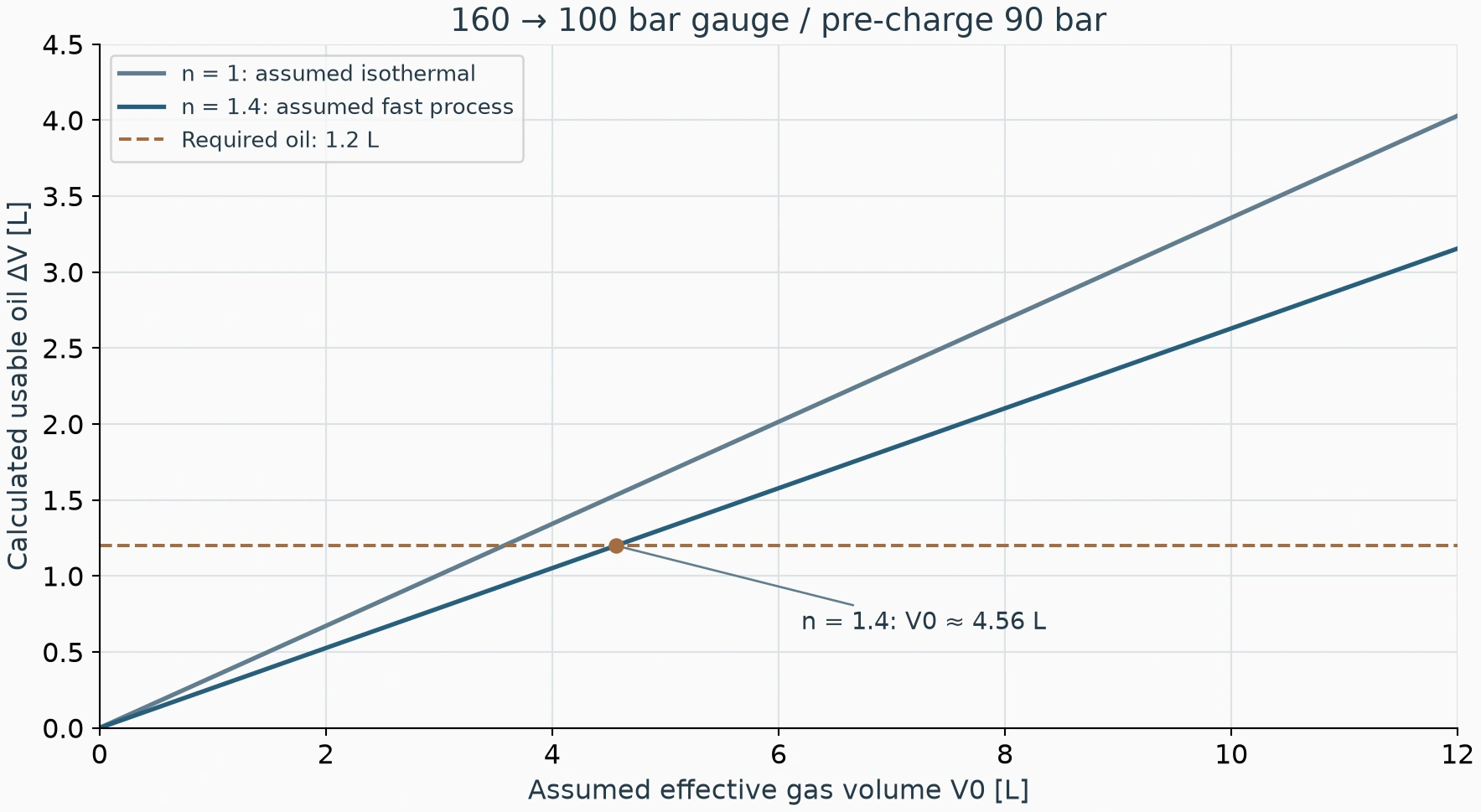
The n = 1.4 model requires approximately 4.56 L of effective gas volume for 1.2 L delivery. Even a nominal 5 L selection has only about 0.11 L of simplified-model reserve. Nominal capacity, actual effective gas volume and engineering margin must be assessed separately.
Minimum pressure comes from the motion requirement
Minimum usable pressure is the pressure needed to finish the rapid stage, not merely an acceptable stopped gauge reading. If the cylinder needs 100 bar and the connecting circuit loses another 10 bar at target flow, 100 bar at the accumulator outlet is insufficient.
Increasing minimum usable pressure to 110 bar with other inputs unchanged reduces available oil and increases required gas volume. Include load and connection losses in the pressure budget.
The connection must also pass the required 36 L/min within the available time. Adequate stored volume does not remove pressure loss through an undersized port, block or check valve.
Select pre-charge with operating temperature
For the applicable bladder energy-storage duty, HYDAC specifies conditions including p0 no greater than approximately 0.9p1 and an allowable pressure ratio. These are selection constraints, not a universal instruction to charge every cold accumulator to 90% of minimum pressure.
Pre-charge changes with gas temperature. Different charging and maximum operating temperatures require the OEM conversion method. Temperature also affects gas state at the end of the rapid event.
Pre-charge verification requires the appropriate nitrogen charging/testing equipment and depressurised hydraulic-side conditions. A running system gauge does not directly measure pre-charge. The 90 bar value is an example input only.
Cycle time must permit replenishment
After discharging 1.2 L, an assumed net recharge flow of 12 L/min requires at least 6 seconds at constant flow. Net flow already excludes other consumption during that interval.
A repeated event every 4 seconds cannot be sustained under that recharge assumption. Actual pump pressure control, reduced delivery near the setting and connection losses can require more time.
| Check | Effect in this example |
|---|---|
| Rapid stage lasting 2 or 3 seconds | Required oil changes from 1.2 to 1.8 L |
| Minimum pressure including connection losses | Defines the usable pressure interval |
| Effective gas volume and thermal process | Determines available discharge |
| Port and block flow capacity | Determines whether 36 L/min can be delivered in time |
| Net recharge flow and cycle spacing | Determines readiness for the next cycle |
SB330 rapid-flow support must satisfy oil volume, end-of-motion pressure, instantaneous flow and repeated recharge together. A 1.2 L demand calculation establishes only the first requirement.