MOOG D633: Diagnosing Uneven Low-Speed Motion
A cylinder that pauses and then jumps at low speed is often blamed on its servo valve. Comparing command, spool monitoring and cylinder motion helps identify which part changes first.
D633 uses a permanent-magnet linear force motor to drive its spool directly, without pilot oil. This article uses Rev. D, November 2024; operating examples are illustrative.
Separate spool position from cylinder position
The valve's LVDT measures spool position for its integrated control loop. A separate machine sensor measures cylinder travel.
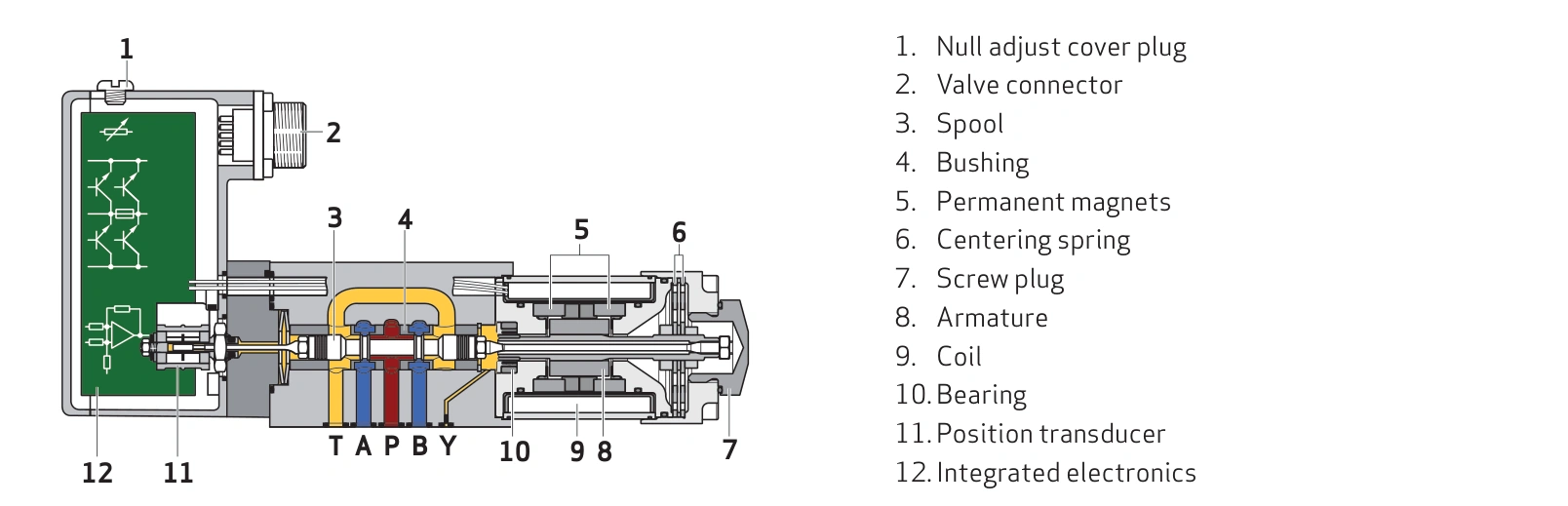
Stable command and spool monitoring with uneven cylinder travel call for checks of seal friction, guides, load and hydraulic conditions. If command changes first and the spool follows, investigate the machine controller and position feedback.
Pressure builds before a sudden movement
Suppose a cylinder is commanded to move at 2 mm/s. Command stays relatively steady while working-chamber pressure rises during each pause. At breakaway, pressure falls and the cylinder jumps. This behaviour is consistent with static friction exceeding moving friction.
Pressure builds until it overcomes resistance; after movement begins, reduced resistance allows acceleration. Check seals, guide alignment, lubrication and load changes. The pattern does not identify a particular worn component without further inspection.
A problem concentrated at one travel position also warrants checking local mechanical contact and side loading. Valve condition requires appropriate electrical and hydraulic assessment.
The controller repeatedly corrects direction
If position error alternates around the target and command repeatedly reverses, check sensor mounting, signal noise and machine control settings.
Spool monitoring that follows these commands indicates that the valve is executing the corrections. Excessive gain, integral accumulation, changing load and hydraulic compliance can contribute to machine-loop oscillation. Qualified commissioning personnel should assess trend records before adjusting settings.
With stable command but abnormal spool monitoring, investigate valve-terminal supply, connections, monitoring integrity and valve response. Rule out sampling and measurement noise first.
The flow grade may be large for fine motion
D633 grades include 5, 10, 20 and 40 L/min at 35 bar per land. A 20 cm² cylinder area moving at 1 mm/s needs only 0.12 L/min.
That is 0.3% of a 40 L/min rating or 2.4% of a 5 L/min rating. These are flow ratios, not direct command percentages: differential, null characteristics and leakage also matter.
Smaller grades merit assessment for fine-flow duties. Where the same machine also needs rapid travel, calculate both requirements before selecting the valve or considering separate supply stages.
Record repeatable conditions
| Observation | Compare | Investigation |
|---|---|---|
| Pressure rises, then cylinder jumps | Command, chamber pressure, travel | Friction, alignment and load |
| Command repeatedly reverses | Command, spool monitoring, position error | Feedback and machine-loop tuning |
| Stable command, abnormal spool monitoring | Valve supply, command and monitoring | Connections and valve response |
| Fast travel normal, very slow travel uneven | Flow grade and low-speed demand | Small-opening behaviour and friction |
Operators can record temperature, speed, travel position and existing trends. Qualified personnel should perform additional electrical, pressure or mechanical work under the machine procedure.
Direct drive removes pilot-oil requirements, but main supply and return conditions still affect flow at a given opening.
Use the timing of command, spool and cylinder changes. Pressure accumulation before breakaway points towards friction checks; command changes first point towards machine control; abnormal spool response under steady command warrants drive and valve investigation.